
The Gage Chicago
A concept study: extending a beloved restaurant's brand into a reservation experience
Role: UI/UX Designer — self-initiated concept study
Subject: The Gage — a real Chicago gastropub on Michigan Avenue with an established brand and dining room
Timeline: 2 months
Platform: Native mobile (iOS)
Scope: IA sketches, 23-screen annotated wireflow, visual design, app icon system, high-fidelity interactive prototype
What it demonstrates: Designing inside someone else's brand — translating a restaurant's physical atmosphere into UI, and resolving a complete reservation experience end-to-end before touching visual design

The Challenge
The Gage is the kind of restaurant that has regulars — an established Chicago gastropub with a strong identity: the ornate monogram, the moody wood-and-brass room, the sense of occasion. My question as a designer: what would it mean for that experience to start before you walk in? Could an app extend the hospitality — reservations, menu, the mood — without cheapening a brand built on atmosphere?
The self-imposed constraint made it a worthwhile exercise: the brand was not mine to change. No new logo, no new palette, no reinvention — the app had to feel like a continuation of the dining room, the way good hospitality feels continuous from the host stand to the table. Designing expressively within a fixed identity is a different muscle than inventing one, and it's the muscle this study was built to train.
"The brief I gave myself: the app should feel like the restaurant's front door, not the restaurant's brochure."
App Icon Design

My typical app icon exploration process was not necessary for this project because the existing brand mark was already distinctive and recognizable. I incorporated the logo directly into the icon to strengthen brand continuity and create an immediate visual connection for users. After testing a small range of color variations, the final direction was quickly refined and approved.
Initial App Sketches
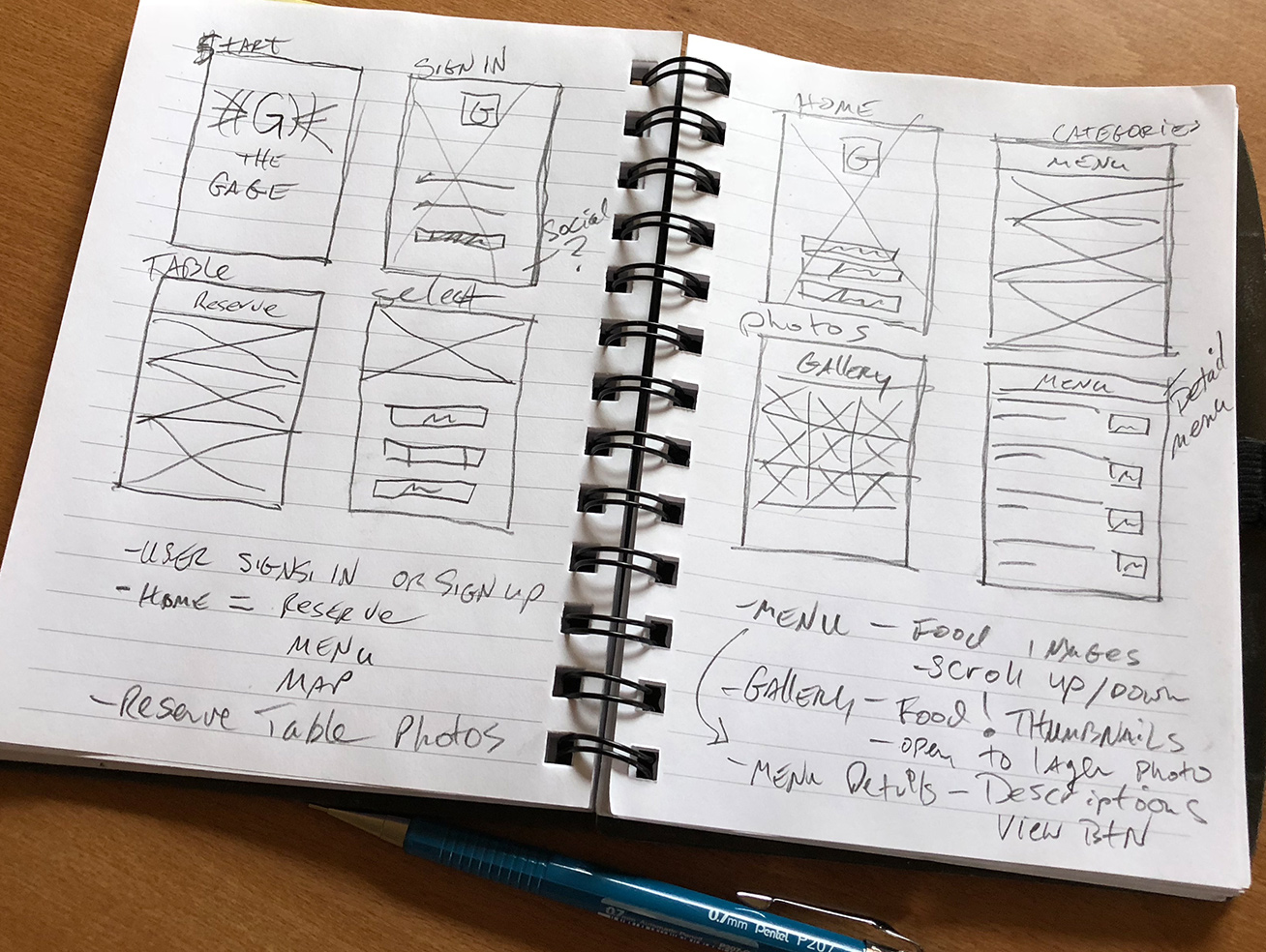
Generating an idea is often the easy part; the real challenge is translating that concept into a clear and intuitive interface. Sketching helps me explore how the product will take shape, define the user journey, and establish the interaction model before moving into higher-fidelity design. My sketches typically begin as small, focused studies and evolve as the user flow and functionality become more defined. This process is essential for evaluating ideas quickly, identifying what works, and eliminating directions that do not support the experience.
Architecture Decisions
Flows before pixels — all of them. From notebook IA sketches (sign-in, home, reserve, menu, gallery, map) I built a complete annotated wireflow: 23 numbered screens with every connection mapped — launch → sign-in → reserve → date/party-size → confirmation, plus menu browsing with item detail, gallery, reviews, and account paths. Nothing went to visual design until every path had an answer.
Reservation as the spine. Everything else in the app — menu, gallery, directions — exists to support one job: get a table with the fewest decisions possible. The home screen makes that hierarchy explicit: Make a Reservation first, View Our Menu second, Get Directions third. One primary action per screen, calendar → party size → confirm, done.
Atmosphere as interface. The visual design borrows the room itself — dark ground, the brass-gold of the monogram, photography of the space as ambient texture — so the app reads as The Gage at first glance, at thumbnail size, in a dark bar. Restraint was the craft here: the brand's ornament lives in the identity layer while the UI layer stays quiet underneath it.
Icon from the brand, deliberately. The Gage's monogram was already distinctive, so the icon work was disciplined variation — testing the mark across dark, light, and brand-gold treatments for shelf presence rather than inventing something new.
Proved in motion. The study ended as a high-fidelity interactive prototype (Proto.io) — the reservation flow tappable end-to-end, because a booking flow's quality lives in its pacing, not its stills.
User Flow Wireframes

Application Screens

Why Concepts?
Why I do concept studies: between client and system work, self-initiated projects like this are where I practice specific muscles without production constraints — here, brand translation and complete-flow rigor. The discipline stays the same: real subject, self-imposed constraints, finished prototype.
What The Study Produced
A complete, prototyped reservation experience — 23 screens, every path resolved, tappable end-to-end.
A worked example of brand-constrained design: an established identity extended to a new medium without alteration.
What I’d Do Now
Ask the strategic question first. A single restaurant probably shouldn't have a standalone app — reservations live on OpenTable/Resy/platform rails, and the honest 2026 version of this brief is "design The Gage's presence within the platforms guests already use, plus the moments that deserve owning." Knowing when the answer is not an app is the judgment this concept era taught me.
Test the prototype, not just build it. The flow was validated by my own walkthroughs; today I'd put it in front of 10-15 diners and let observed friction — not intuition — drive the iteration.
Tokenize the brand translation. The atmosphere-to-UI work was done by eye; I'd now express it as a small token set (the brass-gold, the dark ground, the type pairing) — same discipline I'd later apply at GM and USAA, in miniature.
Design the hospitality moments. The app handles the transaction; the experience opportunities I'd chase now are the softer ones — the pre-visit confirmation that feels like a host's welcome, the post-visit thank-you — where "continuation of the dining experience" actually gets proven.